How to Build a No-Code AI Sales Agent in 2026: The Ultimate B2B Playbook
 |
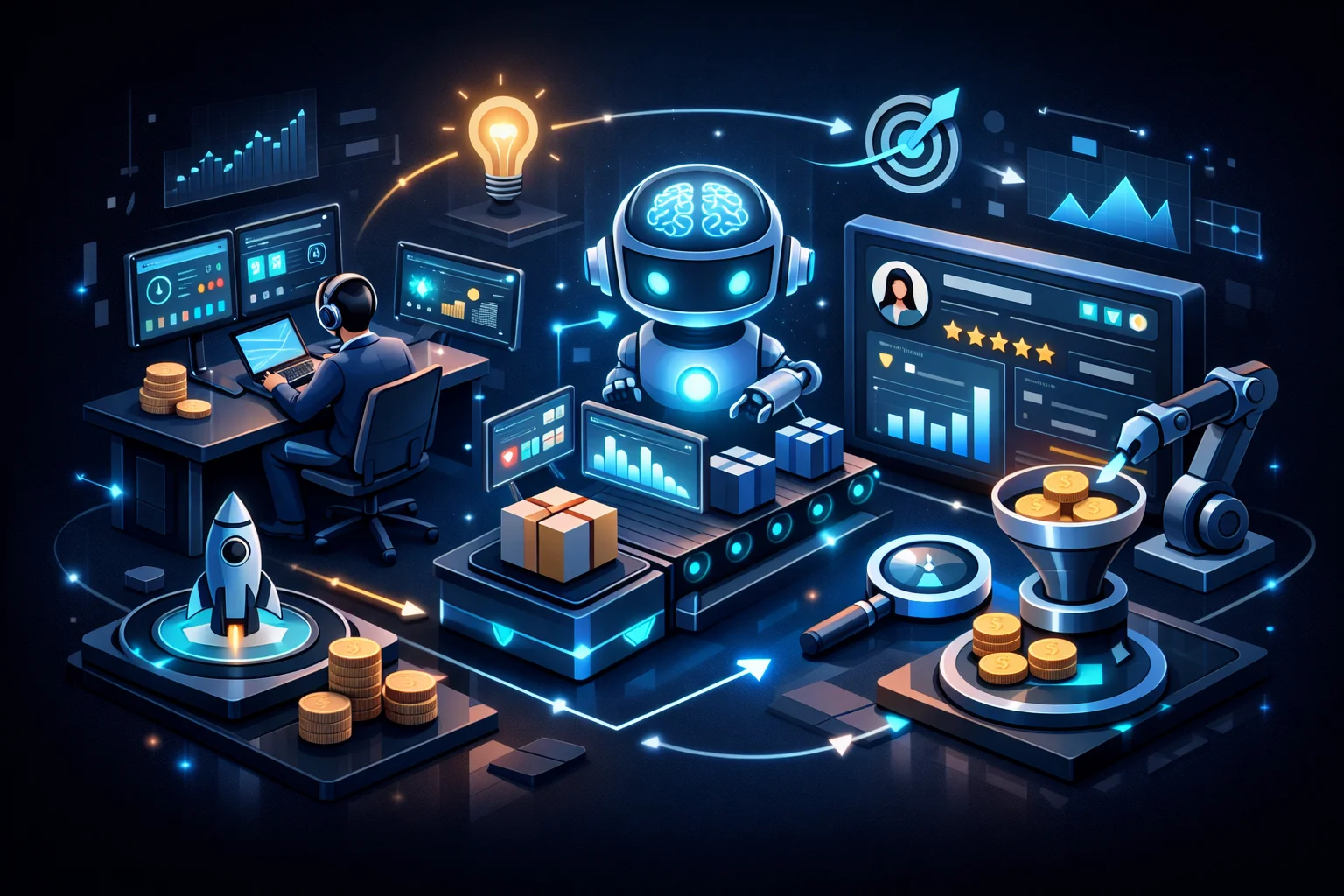
| The future of B2B sales: Building autonomous AI agents for modern marketing. |
An AI Sales Agent in 2026 is not a basic script; it is a goal-oriented, self-correcting cognitive system. It can identify high-intent prospects, craft personalized omni-channel campaigns, handle complex negotiations, answer deep technical product questions, and book meetings directly into your sales team's calendar—all without human intervention. Best of all, thanks to the maturation of enterprise-grade visual interfaces, you no longer need a team of machine learning engineers to build one. You can construct a sophisticated sales agent using completely no-code platforms.
This comprehensive, step-by-step guide is designed for B2B marketing leaders, sales operations specialists, and growth hackers. We will explore the architecture of 2026 agentic technology and walk you through building, testing, and scaling your own enterprise-grade, no-code AI Sales Agent from scratch.
1. The Shift to Agentic Sales: Understanding the 2026 Paradigm
To build an effective AI Sales Agent, we must first understand how AI sales technologies have evolved. In the early 2020s, sales teams relied on "if-then" automation workflows (e.g., if a prospect opens an email, then send follow-up email #2). While useful, these systems were fragile, lacked conversational context, and failed when prospects asked unexpected questions.
In 2026, the industry has standardized on Agentic AI. Unlike rigid workflows, agentic systems are given a goal (e.g., "Qualify this inbound lead and book a demo if they meet our ICP"), access to tools (e.g., CRMs, search engines, calendar APIs), and the autonomy to figure out the best sequence of actions to achieve that goal.
Key Differences: Traditional Automation vs. 2026 AI Sales Agents
- Reasoning vs. Rules: Traditional systems run on predefined rules. AI Agents run on advanced Large Language Models (LLMs) equipped with cognitive architectures (like ReAct or Plan-and-Solve), allowing them to dynamically adapt to a prospect’s unique responses.
- Static vs. Dynamic Personalization: Old systems merged simple database fields (like first name and company name) into a template. Modern AI agents read a prospect’s recent LinkedIn posts, analyze quarterly financial reports, parse their website structure, and write a completely bespoke pitch from scratch.
- Multi-modal capabilities: An AI agent is no longer restricted to text. In 2026, a single agent can initiate a personalized LinkedIn connection, send a highly targeted outbound email, drop an AI-cloned voice mail, and send a customized video presentation.
- Continuous Memory: Agents maintain long-term and short-term memory, meaning they remember past conversations across multiple touchpoints and channels, preventing repetitive and unnatural interactions.
2. The Business Case: Why Build a No-Code AI Agent Today?
The financial and operational arguments for deploying autonomous B2B sales agents are compelling. In a highly competitive economic environment, organizations that successfully deploy these agents achieve unmatched efficiency and scale.
Eliminating the "MQL-to-SQL" Lead Leakage
One of the oldest pain points in B2B marketing is lead decay. When a high-intent prospect downloads a whitepaper or requests pricing, every minute of delay reduces the chances of a successful connection. Research shows that responding within 5 minutes increases conversion rates by up to 391%. A no-code AI Sales Agent works 24/7/365, instantly engaging every incoming lead with custom context, qualifying them on the spot, and routing them to human reps.
Scaling Outbound Without Brand Damage
Mass outbound email spam is dead. Modern email clients use highly sophisticated AI spam filters that block generic blast emails. The only way to succeed in outbound sales today is through high-relevance, low-volume, hyper-targeted outreach. An AI agent can research, write, and execute personalized outreaches at scale, maintaining a high level of quality that feels indistinguishable from human work, preserving your sender reputation and brand integrity.
Dramatic Cost and Time Savings
Developing a custom AI agent through traditional software development can cost upwards of $100,000 and take months of coding, debugging, and API maintenance. No-code agentic development environments have democratized this process, allowing growth teams to build, deploy, and iterate on highly complex sales agents in a matter of days for a fraction of the cost.
3. The Tech Stack for a 2026 No-Code AI Sales Agent
Building a fully functional sales agent requires a modern, modular no-code stack. Instead of a single tool, you will orchestrate a collection of platforms that handle different aspects of the agent's cognition, data access, and action capabilities.
 |
| Visual representation of a modular no-code AI sales agent stack. |
The Core Cognitive Layer (Agent Builders)
- Relevance AI: A leading platform for building autonomous AI agents. It offers built-in memory systems, visual agent builders, and advanced tool integration, making it ideal for sales use cases.
- Flowise / Langflow: Visual, drag-and-drop interfaces for building LLM applications and agentic workflows. These platforms provide deep customization over prompt engineering and vector databases.
- Voiceflow: Originally built for conversational chatbots, Voiceflow has evolved into a premier agent-building platform, supporting complex multi-modal interactions (voice, chat, and email).
The Data & Enrichment Layer
- Clay: The gold standard for data enrichment in 2026. Clay integrates with over 50 data providers (including LinkedIn, Crunchbase, Apollo, and GitHub) to find, filter, and enrich prospect data automatically.
- Apollo.io / Lusha: Essential tools for sourcing accurate contact information, direct dials, and verified B2B email addresses.
- Exa.ai: A search engine specifically designed for AI agents. It allows your agent to perform deep, semantic web searches to understand a company's market positioning, tech stack, and recent press releases.
The Action Layer (Integrations & Delivery)
- Make.com / Zapier Central: Visual integration platforms that connect your AI Agent’s reasoning engine to your business suite.
- Smartlead / Instantly: Specialized cold outreach platforms that handle high-deliverability email sending, inbox warming, and response tracking.
- HubSpot / Salesforce: Your central CRM to store lead status, updated contact details, interaction history, and custom notes written by the agent.
Make.com / Zapier Central: Visual integration platforms that connect your AI Agent's reasoning engine to your business suite. If you want to dive deeper into how this works, check out my guide on how Make.com automation drives business growth.
4. Step-by-Step Guide: Building Your No-Code AI Sales Agent
Now, let’s dive into the step-by-step process of constructing an operational AI Sales Agent. For this walkthrough, we will design an outbound qualification and scheduling agent named "Scribe".
Step 1: Define the Persona, Objectives, and Guardrails
Before touching any software, you must clearly define your agent’s scope of work. Just like a human sales development representative (SDR), your AI agent needs a job description, an understanding of its target audience, and clear boundaries.
Write a detailed system prompt (the instructions that guide the agent's behavior). Below is an enterprise-grade prompt structure for 2026:
ROLE:You are Scribe, an elite B2B Sales Development Representative for [Your Company Name]. Your primary objective is to engage warm prospects, answer their product queries, qualify them based on our BANT (Budget, Authority, Need, Timeline) criteria, and schedule a call with an Account Executive.CONTEXT & PRODUCTS:We sell [Your Product/Service description]. Our core value proposition is [Insert Key Value Prop]. Our ideal customer profile (ICP) is [Insert Target ICP, e.g., Head of Sales at SaaS companies with 50-200 employees].TONE & STYLE:- Professional, confident, consultative, and direct.- Never use generic AI-sounding phrases (e.g., "I hope this email finds you well", "Delve", "Testament", "In today's fast-paced world").- Keep all responses under 150 words. Focus on asking one clear, low-friction question at a time.GUARDRAILS:- Do not make up pricing or features. If a prospect asks about custom enterprise pricing, refer to the pricing sheet tool or escalate to a human.- Never mention that you are an AI unless explicitly asked.- Do not promise discounts.Step 2: Establish the Dynamic Knowledge Base (RAG)
An AI agent is only as good as the information it can access. To answer deep technical questions, legal queries, and pricing concerns, we must connect our agent to a Retrieval-Augmented Generation (RAG) knowledge base.
Using a platform like Relevance AI or Flowise, upload your company’s internal collateral:
- Product Documentation and API structures.
- Up-to-date Pricing Sheets and packaging options.
- Customer Case Studies categorized by industry and pain point.
- Sales Objection handling manuals.
The agentic system will convert these documents into mathematical representations called "vector embeddings". When a prospect asks, "Does your software comply with SOC-2 standards?", the agent will query the database, find the exact section on security compliance, and draft an accurate, context-aware response in milliseconds.
Step 3: Connect Enrichment and Data Tools
To personalize outbound messages, your agent must be able to research prospects on demand. We will build a connection between our agent builder (e.g., Relevance AI) and Clay via an API Webhook.
The workflow functions as follows:
- Your agent receives a name and company domain (e.g., "John Doe, Stripe.com").
- The agent triggers a step to run this data through Clay.
- Clay scrapes John’s LinkedIn profile, Stripe’s hiring board (to see if they are hiring for roles relevant to your software), and Stripe's recent news.
- This enriched payload is returned to the agent as JSON format.
The agent reads this structured information and identifies a specific angle for outreach, such as a recent promotion or an open job requisition, utilizing this context to draft a tailored introduction.
 |
| Essential API integrations to enable tool-calling for your AI sales agent. |
Step 4: Configure "Tool Calling" (The Agent's Hands)
Cognition without execution is useless. To make your sales agent truly autonomous, you must give it "tools"—the ability to execute actions in other software systems. In 2026, major LLMs support native tool-calling (also known as function calling).
Within your no-code builder, you will map your APIs to specific actions. Here are the core tools your agent will need:
| Tool Name | API Endpoint / Connection | What the Agent Does with It |
|---|---|---|
| CRM Lead Sync | HubSpot / Salesforce API | Updates lead status to "Engaged", logs call notes, and updates custom fields. |
| Calendar Booker | Cal.com / Calendly API | Generates a personalized scheduling link or books a slot directly in the calendar. |
| Web Search | Exa.ai / Tavily API | Performs deep web searches to gather real-time business intelligence on target accounts. |
| Email Sender | Smartlead / Gmail SMTP | Sends highly personalized cold or follow-up emails directly from the rep's inbox. |
Step 5: Design the Multi-Agent Cognitive Workflow
While a single agent can handle basic tasks, complex B2B sales cycles require a multi-agent architecture. Instead of asking one generalist agent to do everything, you will assign specialized roles to distinct agents that work in sequence.
For our setup, we will create three specialized agents in our workspace:
- The Researcher Agent: Monitors intent databases (such as G2 and ZoomInfo), identifies accounts showing buying signals, enriches the contacts using Clay, and verifies email deliverability.
- The Copywriter Agent: Receives the research payload, evaluates the prospect's pain points, and crafts a bespoke, persuasive value proposition tailored to their specific context.
- The SDR Agent (Scribe): Monitors inbox replies, processes incoming messages, checks the internal knowledge base for accurate answers, and works to secure a calendar booking.
By splitting these tasks, you create a robust ecosystem that minimizes errors and operates at scale with high precision.
Step 6: Implement Human-in-the-Loop (HITL) Guardrails
In enterprise sales, a single mistake can damage an important relationship. Before giving your AI agent full autonomy, it is crucial to establish a Human-in-the-Loop (HITL) system during the pilot phase.
Using your integration layer (Make.com or Zapier), configure a validation queue. Instead of the copywriter agent sending the email directly to the prospect, program it to send the draft to a designated Slack channel or a visual dashboard (like Retool or Airtable):
[Agent Research & Draft] ➔ [Send draft to Slack Channel #Scribe-Approvals] ➔ [Sales Rep clicks "Approve" or "Edit"] ➔ [Email Sent]
This approach allows your sales team to monitor and refine the agent’s outputs. Once the agent consistently achieves an approval rate above 95%, you can confidently transition it to fully autonomous operations.
 |
| Collaborative AI workflow for reliable sales automation. |
5. Advanced 2026 Personalization Strategies
To achieve high response rates, your AI Sales Agent needs to stand out. Let's look at advanced tactics to differentiate your agent's outreach in 2026.
Dynamic PDF Generation
Instead of sending generic sales decks, configure your agent to generate customized PDFs on the fly. When a prospect engages, the agent can use tools like Docmosis or Bannerbear to insert the prospect’s logo, paint points, and a customized ROI calculation directly into a mini-pitch deck, sending a tailored asset designed specifically for their business.
Social Listening and Trigger-Based Outreach
Configure your Research Agent to monitor social triggers on LinkedIn and industry news sources. For example:
- Funding Rounds: A target account secures Series B funding.
- Executive Hires: A new Head of Sales or CMO is appointed.
- Technology Changes: A target company stops using a competitor's software.
The agent can immediately process these events and initiate outreach. A message starting with, *"Hi Jane, noticed you recently took over as VP of Growth at Acme Corp—given your team's focus on scaling acquisition, I wanted to share how we helped..."* will consistently outperform generic, untargeted emails.
Continuous Self-Optimization
Advanced no-code agent platforms allow you to feed interaction outcomes back into the system. If Scribe receives a negative response, it logs the objection. Over time, the system analyzes which value propositions and email structures generate positive replies and bookings, dynamically adjusting its tone, timing, and copy templates to maximize conversions over time.
6. Ethics, Security, and Compliance in the AI Era
Operating autonomous sales agents comes with important legal and ethical responsibilities. Compliance is not optional, especially in heavily regulated B2B environments.
Data Privacy: GDPR, CCPA, and Beyond
Your agent will actively process personal identifiable information (PII). Ensure your no-code infrastructure complies with international data standards:
- Only store data required to run your campaigns.
- Configure automatic data-deletion routines for prospects who opt out.
- Ensure your tech stack utilizes SOC-2 Certified cloud providers and enterprise-grade encryption.
Transparent AI Engagement
While AI agents are highly capable, honesty remains the best policy. Many B2B buyers appreciate the speed and efficiency of AI, but can react negatively if they feel they were deliberately misled into thinking they were speaking with a human. Consider adding a simple, professional disclosure in the agent's signature, such as:
"Scribe — Autonomous Assistant to [Your Name] at [Company Name]. For feedback or to speak directly with my human counterpart, please reply to this thread."
7. Conclusion: The Competitive Advantage of the Autonomous Agent
Building a no-code AI Sales Agent in 2026 is no longer a futuristic experiment—it is a critical strategy for modern B2B growth. By automating routine data research, lead qualification, and cold outreach, you free your sales team to focus on what humans do best: building deep relationships, running product demonstrations, and closing complex deals.
The transition from manual workflows to autonomous, self-optimizing agents represents a major step forward in sales efficiency. Growth organizations that embrace these no-code technologies today will build a scalable, resilient engine that consistently outperforms the competition.
Start small: build an inbound lead qualification agent, set up robust Slack guardrails, test its outputs, and systematically expand its capabilities. The future of B2B sales is autonomous—and it is time to build yours.
Want to build your own custom AI Sales Agent?
Frequently Asked Questions (FAQ)
Q: Do I need coding experience to build this AI sales agent?
A: No, this entire playbook is built using no-code platforms like Relevance AI, Make.com, and Clay. You only need a logical understanding of workflows.
Q: How long does it take to deploy an autonomous sales agent?
A: With the no-code stack described in this guide, you can prototype and launch a functional agent in a matter of days, rather than months of custom development.
Q: Is it safe to use AI for customer communication?
A: Yes, provided you implement the "Human-in-the-Loop" (HITL) guardrails and strictly follow data privacy guidelines like GDPR and CCPA mentioned in this guide.
Q: Can these agents handle complex sales negotiations?
A: They excel at qualification and initial outreach. For deep, complex negotiations, the agent should be configured to escalate the conversation to a human sales representative.

.png)

No comments:
Post a Comment
Please keep your comments respectful and relevant. No spam or promotional links are allowed.